Select Starknet or zkSync for cheaper ZK transfers
The cheapest ZK transfer is not a chain, it is a moment. I’ve watched a simple token move cost less on zkSync Era at breakfast, then flip in Starknet’s favor later the same day because Ethereum L1…
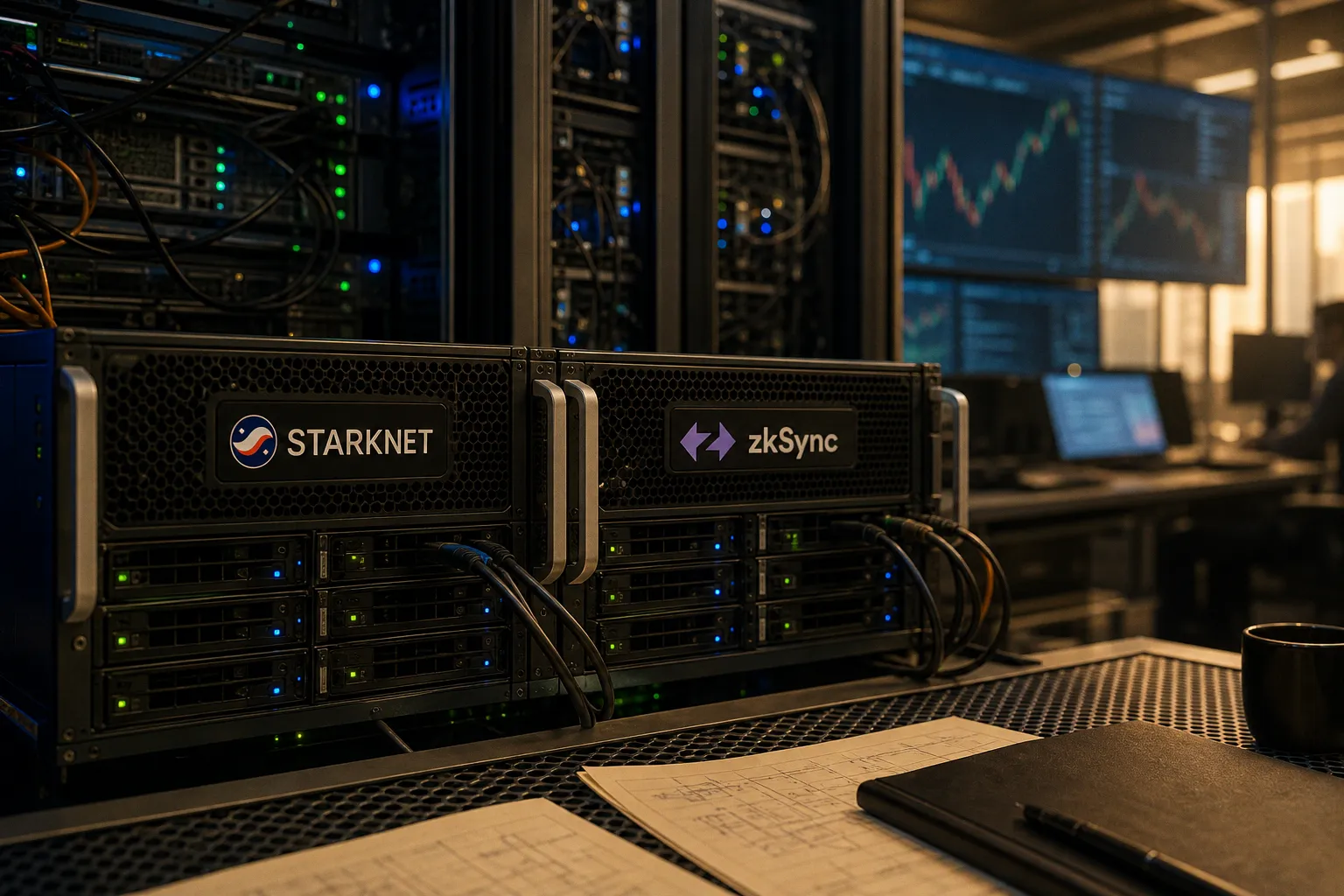
The cheapest ZK transfer is not a chain, it is a moment. I’ve watched a simple token move cost less on zkSync Era at breakfast, then flip in Starknet’s favor later the same day because Ethereum L1 base fee moved, calldata costs shifted, and one network got busier than the other.
So if you’re asking how to check select Starknet or zkSync for cheaper ZK transfers, the answer is not “pick zkSync” or “pick Starknet.” That’s lazy. The answer is: compare the live fee stack before you sign, understand what part of the fee you’re actually paying, and don’t let a wallet quote bully you into a bad route.
ZK-rollup fees are dynamic. If someone tells you one is always cheaper, they are either simplifying too hard or selling you something.
The fee you see is not one fee
Here’s the part many users miss: when you send tokens on Starknet or zkSync, you are not only paying for “gas on the L2.” You are paying for a bundle.
Both networks settle back to Ethereum. That means your transfer cost usually has two major pieces:
- L2 execution fee: the cost of running the transaction inside the rollup.
- L1 data availability fee: the cost of posting enough transaction data back to Ethereum so the rollup remains verifiable and recoverable.
That second piece is why Ethereum congestion still matters. Even if you never touch Ethereum mainnet directly, the rollup does. When L1 base fee rises in Gwei, L2 fees can rise too because the rollup’s data publication gets more expensive.
This is also why “ZK-rollups are cheap” is true in the broad sense but dangerous as a trading instruction. L2 transfers are typically 10x to 100x cheaper than Ethereum L1, depending on load. Great. But if you’re moving size, batching multiple wallets, claiming airdrops, or repositioning liquidity, the difference between two ZK networks still matters.
If you’re sending $18 of a token, maybe you don’t care whether the fee is a few cents higher. If you’re rotating through 40 wallets or moving collateral before a liquidation buffer gets ugly, you absolutely care.
Starknet and zkSync do not meter the same machine
Starknet and zkSync both sit in the ZK-rollup bucket, but they are not interchangeable pipes with different logos.
zkSync Era is EVM-compatible. That matters because its transaction model feels closer to Ethereum for users and developers. Wallet flows look familiar. Contracts often mirror Ethereum-style logic. Gas behavior can resemble what EVM users expect, even though zkSync uses ZK-proofs to compress costs compared with L1.
Starknet is different by design. It uses Cairo and its own STARK-based proof system. That gives it a distinct execution environment and different fee patterns. If you’re coming from EVM chains, Starknet can feel less plug-and-play. But different does not mean worse. It means you should stop comparing only the headline transfer fee and start looking at the transaction type, contract path, and wallet quote.
The practical difference: a basic ETH transfer, an ERC-20-style token transfer, a swap, and a bridge interaction can diverge across networks. The cheapest network for one action may not be cheapest for another.
| Parameter | Starknet | zkSync Era |
|---|---|---|
| Execution environment | Cairo-based, non-EVM native | EVM-compatible |
| Proof system | STARK-based | ZK-proof rollup architecture |
| Fee token | ETH | ETH |
| Fee components | L2 execution plus L1 data availability | L2 execution plus L1 data availability |
| User experience | More distinct tooling and wallet assumptions | More familiar to Ethereum/EVM users |
| Best comparison method | Live fee quote plus tracker check | Live fee quote plus tracker check |
That table is not a verdict. It’s the reason there can’t be one static verdict.
I’ve tested enough L2 flows to distrust any “cheapest chain” claim that doesn’t mention the timestamp, transaction type, and L1 base fee. You can be right for five minutes and wrong for the next block window.
How to check select Starknet or zkSync for cheaper ZK transfers
Here’s the workflow I use before moving funds on either network. It takes less than a minute when you’re practiced, and it saves more than it sounds like if you transact often.
1. Check a live L2 fee tracker first.
Use a real-time comparison source such as L2Fees.info to see current estimated transaction costs across Layer 2 networks. You want the live market, not a blog post from last quarter.
2. Compare the exact transaction class.
A simple transfer is not a swap. A swap is not a bridge. A claim is not a liquidity add. If the tracker shows generic transfer fees, treat that as a baseline, not a final quote.
3. Open your wallet or dApp quote on both networks.
If the token exists on both Starknet and zkSync and you can choose either path, simulate the transaction. Don’t sign. Just look at the network fee estimate.
4. Check Ethereum L1 congestion.
If L1 base fee is spiking, both rollups can get more expensive because of data availability costs. The chain with lower L2 execution may still lose once L1 posting cost gets baked into the final estimate.
5. Watch for bridge drag.
If your funds are already on one network, moving them to the other just to save a few cents on a transfer can be ridiculous. Bridge fees, withdrawal delays, and execution risk can erase the savings.
6. Price the full route, not the final hop.
If your actual goal is “get token X from wallet A to wallet B,” the cheapest route may be staying where the funds already are. The lowest visible transfer fee is not always the lowest total cost.
That last point is where users leak money. They compare Starknet transfer fee versus zkSync transfer fee as if capital teleports between ecosystems for free. It doesn’t.
The wallet quote is useful, but don’t worship it
Wallet fee estimates are necessary. They are not sacred.
A wallet quote can be stale, padded, conservative, or sensitive to the exact contract call being prepared. Sometimes the dApp gives one estimate, the wallet displays another, and the final transaction lands at a slightly different cost.
That does not mean the system is broken. It means fee estimation is probabilistic in a moving market.
The useful habit: treat the wallet quote as your execution quote, and the fee tracker as your market quote. When both point the same way, you have a cleaner decision. When they disagree, slow down.
For example:
- If L2Fees.info shows zkSync transfers cheaper, and your wallet also quotes zkSync cheaper, the decision is easy.
- If the tracker shows Starknet cheaper but your Starknet wallet quote is higher for the specific token transfer, believe the specific transaction quote.
- If both fees are tiny relative to the amount transferred, don’t over-optimize and create bridge risk for no reason.
- If you’re batching many transactions, re-check after a few sends. Network conditions can move while you work.
Critical risk warning: do not approve, bridge, or swap just because you are chasing a lower network fee. Smart contract risk, bridge risk, token liquidity, and failed transactions can cost far more than gas.
This is especially true when users run multi-step routes through unfamiliar dApps. Saving $0.20 on gas while signing an unlimited approval into a contract you haven’t reviewed is not optimization. It’s cosplay risk management.
Why Ethereum L1 congestion still hits your L2 bill
Rollups reduce cost by moving execution off Ethereum mainnet, but they still inherit Ethereum’s settlement economics. That’s the deal.
The L1 data availability portion of your fee can become the heavy part when Ethereum gets crowded. During quiet periods, both Starknet and zkSync can feel almost frictionless. During busier periods, the L2 advantage remains, but the gap between rollups can change quickly.
Think of the fee stack like this:
- Ethereum L1 base fee rises → posting rollup data becomes more expensive.
- L2 activity rises → local execution demand can rise.
- Specific dApp complexity increases → contract interaction costs more than a simple send.
- Wallet fee buffer changes → displayed quote may overestimate to avoid failure.
This is why I don’t like static fee tables unless they’re clearly labeled as snapshots. They age badly. A transfer cost screenshot is useful evidence for that moment, not a law of nature.
The same logic applies outside crypto: trend snapshots age fast. You wouldn’t treat last season’s runway notes as a permanent map of demand, even if you follow fashion trends and runway coverage closely. Markets rotate. Fees rotate faster.
Starknet’s fee behavior: where the edge can appear
Starknet’s architecture gives it a different cost profile because it is not just “Ethereum but cheaper.” Cairo, account abstraction patterns, and STARK-based proving create a distinct environment.
Where Starknet can look attractive:
- Native Starknet activity where the dApp is built for its execution model rather than ported awkwardly.
- Periods when Ethereum L1 is calm and the network’s own execution cost is competitive.
- Users already holding funds on Starknet, because avoiding a bridge often beats hunting marginal gas savings elsewhere.
- Transactions in ecosystems where Starknet liquidity and routing are good enough that you don’t pay hidden spread through poor execution.
But there are trade-offs.
Tooling can feel less familiar if you live mostly in EVM wallets. Some assets have thinner liquidity compared with larger EVM environments. And if you need to move in and out through bridges, you need to price the whole path.
I’m not bearish on Starknet for that. I’m saying don’t compare networks in a vacuum. If the transfer is cheap but the route to get there is clunky, your final cost may be worse.
zkSync’s fee behavior: where it wins in practice
zkSync Era’s EVM compatibility gives it a very practical advantage: familiarity. If your workflow already spans Ethereum, Arbitrum, Optimism, Base, and other EVM-style environments, zkSync feels easier to reason about.
Where zkSync can look attractive:
- EVM-native users who want familiar wallets, approvals, and contract patterns.
- Token transfers involving assets already liquid on zkSync, avoiding extra bridge hops.
- dApps that mirror Ethereum-style execution cleanly, making quotes easier to interpret.
- Operational flows across many wallets, where UX speed matters almost as much as raw gas.
But again, don’t turn convenience into a guarantee. zkSync can be cheaper for a transfer at one moment and more expensive later. Network activity changes. L1 cost changes. Contract complexity changes.
If your question is specifically how to check select Starknet or zkSync for cheaper ZK transfers token, you should add token-level friction to the comparison. Ask: is the token native, bridged, liquid, and supported by the wallet and dApp route you plan to use?
A cheap fee on a network where the token route is thin can get eaten by slippage or bridge complexity.
The hidden costs that make “cheaper” a trap
Gas is the visible cost. It is not the only cost.
When I test L2 routes, I separate costs into four buckets:
| Cost type | What it looks like | Why it matters |
|---|---|---|
| Network fee | ETH paid for the transaction | The obvious Starknet vs zkSync comparison |
| Bridge fee and delay | Moving assets between networks | Can erase small gas savings fast |
| Slippage | Worse execution on swaps | Often bigger than transfer fees |
| Operational risk | Wrong network, failed tx, bad approval | The expensive mistake nobody models |
For simple wallet-to-wallet transfers, the network fee may dominate. For anything involving swaps, bridging, or DeFi positioning, the other buckets can matter more.
This is where DeFi users get sloppy. They’ll spend ten minutes optimizing a $0.40 gas difference, then accept 80 basis points of slippage because the interface looked clean. Don’t do that.
If you are moving meaningful size, run the math in dollars:
- Fee on Starknet in ETH terms.
- Fee on zkSync in ETH terms.
- Any bridge fee required to reach either network.
- Expected slippage if the transfer is part of a swap route.
- Time cost if withdrawal or settlement timing matters.
- Failure cost if you need to resubmit.
Now you’re comparing actual execution cost, not vibes.
When timing matters more than network choice
If you’re not under pressure, timing can beat chain selection.
Because both networks inherit some cost from Ethereum L1 data availability, waiting for calmer L1 conditions can reduce fees across the board. Weekend periods or lower-activity windows may produce better quotes, though there’s no guarantee. Crypto does not respect your calendar.
For high-volume transaction batches, I use a simple rule: quote before the batch, quote during the batch, and stop if fees drift beyond the threshold I set.
That sounds basic. It works.
Say you need to send tokens from 30 wallets. The first five quotes look cheap on zkSync. Great. But if L1 base fee jumps or network activity spikes halfway through, your later transfers may cost more. Don’t blindly finish the batch because the first quote looked good.
The cheapest rollup is the one that is cheap for your transaction, with your funds already positioned, at the moment you sign.
That sentence is the whole game.
A practical decision model for Starknet vs zkSync
Use this when you need a fast call.
Choose Starknet if:
- Your funds are already on Starknet.
- The live tracker and wallet quote both show lower cost for your transaction.
- The token route is clean and liquid enough.
- You are comfortable with Starknet-native wallets and dApps.
- You are using a protocol built specifically for Starknet’s environment.
Choose zkSync Era if:
- Your funds are already on zkSync.
- You want EVM-compatible UX and tooling.
- The live fee quote is lower for the exact transaction.
- The token has better support or liquidity on zkSync.
- You are operating across EVM-style workflows and want less friction.
Do not switch networks just because:
- A social post says one is cheaper.
- A fee screenshot looks good without a timestamp.
- You are saving cents but adding bridge risk.
- You don’t understand the approval or contract you’re signing.
- You are ignoring slippage, liquidity, or failed transaction risk.
This is not maximalist advice. It’s execution advice.
What I’d do before sending size
For a small transfer, I’ll usually stay on the network where the funds already sit unless the fee difference is absurd. Moving funds across ecosystems to save dust is not smart.
For a larger transfer, or a batch of transfers, I do this:
1. Open a live L2 fee tracker and compare current Starknet and zkSync estimates.
2. Check Ethereum L1 gas conditions.
3. Simulate the exact transfer in the relevant wallet or dApp on both networks if possible.
4. Confirm the token route is supported and liquid.
5. Avoid unnecessary bridging unless the savings clearly justify the extra risk.
6. Send a small test transaction if the amount is meaningful or the route is unfamiliar.
7. Re-check fees before sending the rest.
That may feel like overkill until the day it saves you from a bad bridge route, a failed contract call, or a fee spike during a batch.
The bottom line
Starknet versus zkSync is not a permanent cheapest-network contest. It’s a live execution decision.
Both can deliver transfers far cheaper than Ethereum L1. Both pay fees in ETH. Both combine L2 execution cost with L1 data availability cost. Both fluctuate with Ethereum congestion and network-specific demand. And because Starknet uses Cairo and a STARK-based system while zkSync Era is EVM-compatible, the same action can price differently across the two.
So the right move is simple: check live fee trackers, compare wallet quotes for the exact transaction, price the full route, and only then sign.
If you want the cheapest ZK transfer, stop asking for a fixed winner. Build the habit. The market will keep moving whether your gas plan does or not.